
Heat Exchanger Maintenance Procedure for PTFE and Plastic Units – Safety Tips & Cleaning Guide (PDF)
How to maintain your PTFE Heat Exchanger. Our recommended maintenance procedures suitable for Empire’s manufactured range of fluoropolymer heat exchangers.
Plastic Heat Exchangers – especially those made from PTFE, PFA, or FEP are considered an essential piece of kit for aggressive chemical environments like metal finishing, plating, and wastewater treatment. But to keep them operating at peak performance and extend their lifespan, regular maintenance is necessary.
Here are Empire Pumps’ recommended heat exchanger maintenance procedures suitable for Empire’s manufactured range of Fluoropolymer Heat Exchangers.
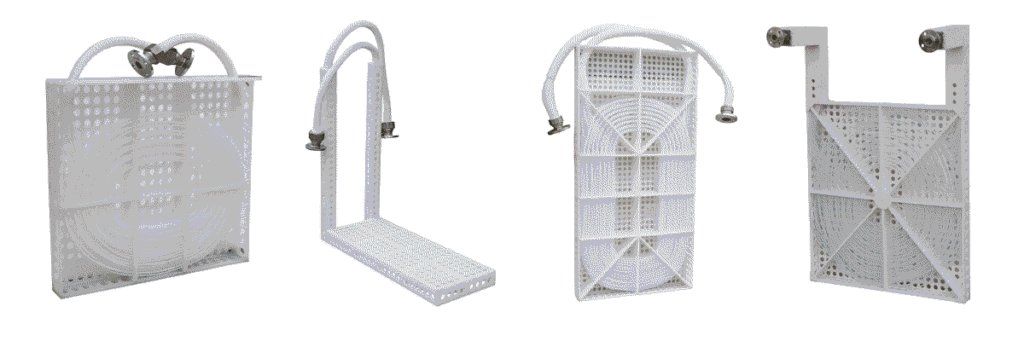
Empire Pumps manufactured bespoke PTFE Heat Exchangers
🔐 Safety Precautions Before Maintenance
Before any inspection or cleaning, here are some safety guidelines to follow:
- Wear protective equipment, including gloves and face protection.
- Ensure the unit is drained and depressurised.
- Confirm that the heat exchanger is compatible with the fluids and temperature range to which it has been exposed.
- Never service under pressure or while connected to a charged tank.
- Avoid heat exchanger contact with overhead conveyors or metal framework, and always support pipework separately from the unit.
- Prior to maintenance, please go through the operations and maintenance instructions to ensure proper understanding. Download Operations & Maintenance Instruction
🛠️ Maintenance Procedure for PTFE & Plastic Heat Exchangers
1. Visual Inspection
Look for signs of leakage, chemical residue, stress on joints, or changes in surface colour suggesting corrosion or incompatibility.
2. System Shutdown
- Fully close suction and discharge valves.
- Relieve system pressure.
- Disconnect both ports and lift the unit using safe manual handling or lifting gear.
3. Flushing & Neutralisation
Flush the unit with neutralising agent (compatible with the chemicals). Avoid high-pressure cleaning. Use soft brushes to remove scaling.
4. Decontamination
For units exposed to hazardous materials, ensure full chemical neutralisation and collect any waste according to environmental regulations. Never expose PTFE internals to aggressive cleaning tools.
5. Reinstallation
- Check all gaskets and seals.
- Reconnect suction and discharge pipework, ensuring no mechanical stress is placed on flanges.
- Open valves fully during startup.
⏱️ Frequency of Maintenance
We suggest completing routine checks to maintain peak performance and lifespan. This includes:
- Visual inspection: Monthly.
- Full flush and neutralisation: Every 6–12 months.
- Immediate inspection if any noticeable fluid changes, signs of performance drop or leaks.
💡 Additional Caution & Tips
- Make sure no sharp objects are present to avoid piercing the heat exchanger tubing.
- Avoid metallic piping on plastic flange models.
- We recommend high/low level alarms are used to avoid tank siphoning or overflow risks.
- Avoid using dirty heating oil, as it can crystallise and cause blocked tubes.
- Ensure correct pipe bore and minimal bends to avoid reduced flow and poor heat transfer.
📎 Need More Information or Access to Full O&M’s?
Learn more about our range of bespoke PTFE Heat Exchangers.
See or download our Heat Exchanger Operating and Maintenance Instructions pdf (O&M).
Read our latest Heat Exchanger Case Study PTFE Heat Exchanger for an Automotive Parts Manufacturer
Need further information?
Contact us today on 0161 637 3003 or email us at [email protected]
or follow us on our social media channels:
